
Automatic Opening Vents (AOVs): Compliance & Safety Guide
Understanding Automatic Opening Vents (AOVs)
In a building fire, smoke poses a far more immediate threat to human life than flames. Toxic gases and dense smoke can fill corridors and escape stairwells within minutes, disorienting occupants and blocking evacuation routes. Automatic Opening Vent (AOV) systems are a critical component of active fire safety in multi-storey residential blocks, commercial facilities, and complex public buildings. By venting heat and smoke out of the premises, AOVs keep escape pathways clear and provide safe access for responding fire and rescue services.
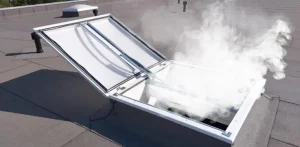
What is an Automatic Opening Vent (AOV) System?
An AOV is a motorised vent, window, damper, or roof hatch designed to open automatically upon detecting smoke or heat. They are strategically positioned where smoke accumulation threatens escape routes, including top-of-stairwell roofs, corridor windows, vertical smoke shafts, and lift lobbies.
+-------------------------------------------------------------------------+
|                        AOV Activation Sequence                          |
+-------------------------------------------------------------------------+
|  1. Detection    -->  Optical sensor identifies smoke in a zone         |
|  2. Signal       -->  Control panel receives signal; activates zone     |
|  3. Operation    -->  Actuator opens vent/damper to tested angle        |
|  4. Ventilation  -->  Hot smoke exhausts upwards via thermal buoyancy    |
|  5. Override     -->  Firefighters adjust vents via key-switch panel    |
+-------------------------------------------------------------------------+
Key System Components & Features
- Actuators & Motors: Electric drive units (chain, spindle, or folding arm) that open the vents.
- Control Panels & Secondary Power: The system hub equipped with dedicated battery backup supplies to ensure full operation during a mains power failure.
- Environmental Sensors vs. Fire Priority: Dual-purpose systems may use wind and rain sensors for comfort ventilation, but these are automatically bypassed instantly if a fire signal is detected.
- Smoke Shaft Dampers: Vertical shafts running through multi-storey blocks use motorised dampers on individual floors to isolate and vent smoke from the affected floor while keeping other levels sealed.
- Fireman’s Override Switch: A key-operated manual switch at the fire service access point, allowing fire crews to open, close, or redirect smoke away from their entry route.
The UK Legal Framework and Standards
Building owners, facilities managers, and designated Responsible Persons must ensure smoke control systems meet strict statutory requirements across their operational lifecycle.
1. Regulatory Reform (Fire Safety) Order 2005
Under the Fire Safety Order, the Responsible Person must maintain all fire safety equipment and life-safety systems in efficient working order and good repair. Failing to maintain an operational AOV system can result in enforcement notices or prosecution.
2. The Building Safety Act 2022 & The “Golden Thread”
For Higher-Risk Buildings (HRBs), paper record-keeping is no longer sufficient. Duty holders must maintain a digital Golden Thread of building information, meaning every inspection, fault, battery replacement, and service record must be digitally logged for auditability.
3. Relevant British Standards
- BS EN 12101: Specifications for smoke and heat control systems (including vents, control panels, and power supplies).
- BS 9999: Code of practice for fire safety in the design, management, and use of buildings.
- BS 7346-8: Components for smoke management systems and codes of practice for planning, installation, and servicing.
Testing, Inspection, and Competency Schedules
Regular maintenance prevents failures caused by mechanical sticking, battery degradation, or electrical faults. While internal teams can handle routine visual checks, formal servicing requires accredited technical competence.
| Inspection Level | Frequency | Responsibilities & Scope |
| Weekly Check | Weekly | Responsible Person / In-house staff: Visual check of panel for fault lights; run a test on a selected zone to verify actuator operation. |
| Monthly Test | Monthly | Responsible Person / In-house staff: Test secondary battery backup supplies and manual override switches. Log digitally. |
| Full Service | Bi-Annually / Annually | Competent Specialist Engineer: Full mechanical and electrical inspection (BS 9999 / BS 7346-8), ideally verified via third-party accreditation (e.g. FIRAS, BAFE). |
Knowledge Testing & Duty Holder Training
Understanding smoke control mechanics, legal obligations, and routine inspection protocols is vital for anyone managing commercial or residential properties.
- To evaluate your current understanding of smoke ventilation regulations, system components, and testing schedules, complete the free online AOV Mock Test.
- For duty holders, estate managers, and safety officers seeking a clear understanding of their legal compliance obligations, structured learning is available through the online Automatic Opening Vent (AOV) Training Course.
Frequently Asked Questions (FAQs)
What is the difference between natural and mechanical smoke ventilation?
Natural smoke ventilation relies on thermal buoyancy—hot smoke rising and exiting through open roof hatches or external windows. Mechanical smoke ventilation uses powered extraction fans to pull smoke out of complex, deep-plan, or basement spaces where natural airflow is insufficient.
Do AOVs require backup battery power?
Yes. British Standards mandate that AOV systems include dedicated secondary battery power supplies capable of operating the vents even if primary electrical power fails during a fire.
Who is legally responsible for AOV compliance in multi-occupancy buildings?
Under UK law, the Responsible Person (typically the building owner, landlord, employer, or managing agent) holds primary legal accountability for ensuring safety systems are inspected, tested, and maintained.
What is the difference between stairwell AOVs and smoke shaft dampers?
A top-of-stairwell AOV protects the main emergency staircase by venting smoke out the top of the roof. Smoke shafts use motorised dampers on individual corridor floors to vent smoke from a specific storey into a vertical shaft without allowing smoke to migrate to other floors.
Conclusion
Smoke ventilation systems are among the most critical life-safety installations in modern buildings. Keeping AOVs operational through regular testing, digital record-keeping, and knowledgeable oversight ensures that escape routes remain clear when every second counts.nsure your property remains fully compliant and safe.