
Online | 1 Hour
Ladder Safety Course
(219 reviews)
Save 50% - Sale Ends Soon
Online | 1 Hour
Ladder Safety Awareness Course
(219 reviews)
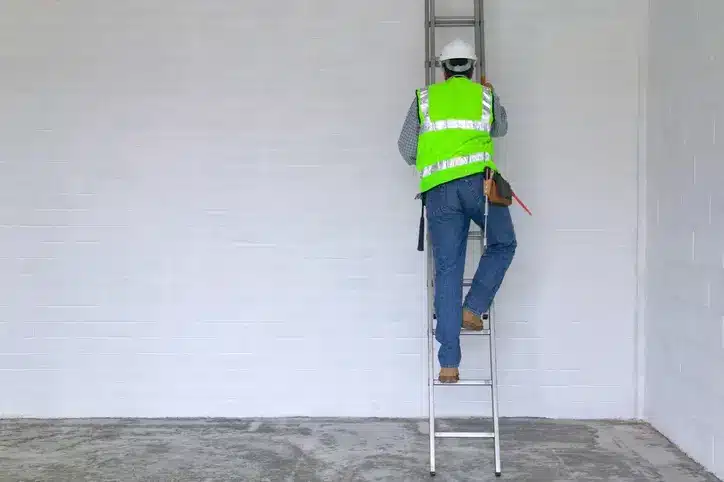
The Level 1 Award in health & Safety in a Construction Environment is required to apply for the CSCS Green Labourers Card. Complete our popular online course and test in less than a day at home avoiding the need to attend a training centre and will allow you to get certified fast.
£14.00
£28.00 Save 50%

Free Test Resits
Meets Regulations
Verifiable Certificate
Complete At Your Pace
Suitable For All Workplaces
Director
Team Leader/ Manager
Teacher
Administrator
100% Online Ladder & Stepladder Safety Awareness Course Completed At Your Own Pace. This interactive course covers how to use ladders & stepladders to reduce the likelihood of accidents happening in the workplace.

Who Should Take This Ladder Inspection Course?
This course is suitable for those working in environments which could be contaminated with H₂S gas at all experience levels.Receptionist
Oil & Gas Workers
Supervisors & Managers
Petroleum & Refinery Staff
Confined Space Operatives
What's Covered In This Ladder Inspection Course?
This course provides practical guidance on identifying H₂S hazards and responding safely to protect both the individual and their colleagues.- Risk Assessment & Equipment Hierarchy: Legally, ladders should only be used for short-duration (under 30 minutes) or low-risk tasks where more suitable equipment (e.g., scaffolds or podiums) is not justified.
- Competence Requirement: Anyone managing, inspecting, or using ladders must be trained and competent under the Work at Height Regulations 2005.
- Equipment Standards: Workplace ladders must meet recognised UK/European standards (such as EN131 Professional rating).
- Duty of Care: Employers and duty-holders are legally required to ensure equipment is maintained, regularly inspected, and safe to use.
- Stiles & Rungs Integrity: Inspect stiles (side rails) for bends, cracks, twists, or corrosion, and check that rungs are clean, intact, and firmly fixed.
- Feet & Anti-Slip Devices: Ensure top and bottom feet are free from damage, wear, or missing pads, and clear of mud, oil, or debris.
- Setup & Angle Compliance: Verify the ladder can be set at the 75° angle (1-in-4 rule) and rest against a solid, non-fragile upper surface.
- Securing Mechanisms: Confirm that ties, stability devices, or levelers are operational and free from defect.
-
Locking Mechanisms & Restraints: Check that spreaders, locking bars, and hinges open fully, engage securely, and show no signs of distortion or damage.
-
Platform & Tread Inspection: Verify that treads are clean, level, and securely fastened, and that the top platform (if applicable) is not buckled or split.
-
Four-Point Ground Contact: Ensure all four feet touch the ground evenly and that anti-slip caps are present and unworn.
-
Top Step / Treads Limits: Ensure the stepladder rating permits the user to work without stepping on the top 3 steps (unless designed with a safety handrail/platform).
-
Traceable Equipment Identification: Importance of every ladder having a unique asset code or tag that links directly to its inspection record.
-
Audit Trail & Retention: Maintain clear digital records detailing inspection dates, results, inspector identity, and any identified defects for legal compliance.
-
Real-Time Fault Reporting: How to use the course eChecklists to enable immediate reporting and logging of unsafe equipment before work begins.
-
Immediate Quarantine: Instantly remove damaged or failed equipment from service to prevent unauthorized use.
-
Physical Tagging: Apply a high-visibility, physical "DO NOT USE" or quarantine tag directly onto the defective ladder.
-
Formal Escalation & Logging: Report the failed inspection to the designated supervisor or safety manager and update the asset management register.
-
Repair vs. Scrapping: Ensure repairs are carried out strictly by authorised manufacturers/specialists, or destroy and dispose of unsalvageable ladders safely.
Industry Recognised Certificate + Free Resits
Take the multiple-choice course test anytime on any device. Certificates are available instantly, valid for 3 years & can be verified on our website. Free resits are included.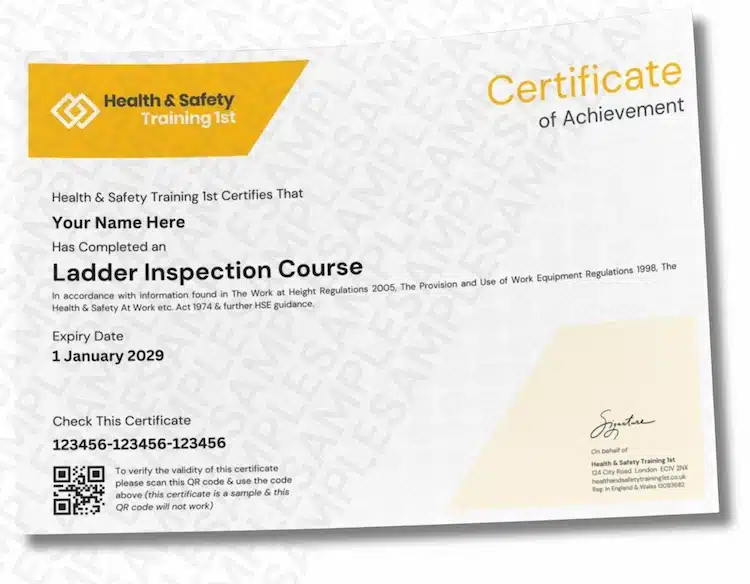
Ladder Inspection Practice Test
Want to see how much you already know about Ladder Inspections? Try our practice test which includes course questions & get instant feedback.Comply With Regulations
This Online Ladder Inspection for Managers & Supervisors course enables employers to meet their statutory obligations under the Work at Height Regulations 2005 and the Provision and Use of Work Equipment Regulations 1998 (PUWER), which require ladders to be regularly inspected.Ladder Inspection FAQs
Under the Work at Height Regulations 2005 & PUWER (Provision and Use of Work Equipment Regulations 1998), employers must ensure that all ladders and stepladders are inspected by a competent person at regular intervals.
This course is designed for site supervisors, safety officers, duty holders, maintenance staff, line managers, and self-employed tradespeople responsible for managing workplace equipment. If you carry out pre-use checks, manage equipment registers, or perform detailed periodic visual examinations on ladders and stepladders, this course provides the necessary skills to identify defects and keep accurate compliance records.
Yes, our online ladder inspection training is 100% web-based, allowing you to complete the modules and theory assessment at your own pace from any device. The e-learning covers critical theory including UK health and safety legislation, defect identification (stiles, rungs, feet, and locking mechanisms), risk assessment, and legal record-keeping.
According to HSE guidance, ladders require two types of checks: pre-use checks (carried out daily or before each use by the operator) and detailed formal visual inspections carried out at fixed intervals by a competent person. Depending on workplace risk, frequency of use, and environment, formal visual inspections typically occur every 3 to 6 months and must be formally documented in a ladder inspection register.
A pre-use check is a quick visual and operational check performed by the ladder user before starting a task to look for immediate safety hazards like oil, bent rungs, or missing feet.
100% Online Ladder & Stepladder Safety Awareness Course Completed At Your Own Pace. This interactive course covers how to use ladders & stepladders safely to reduce the likelihood of accidents. Suitable for all workplaces it meets UK regulations. Includes instant industry recognised certificate & free test resits.
Interactive Course Material
Suitable For All Workplaces
Learn at Your Own Pace
Practical Guidance
Who Should Take This Ladder Safety Course?
This course is suitable for those who use Ladders & Stepladders in any workplace at all levels.What’s Covered In This Ladder Safety Course?
This course provides practical guidance on inspecting ladder H₂S hazards and responding safely to protect both the individual and their colleagues.- Risk Assessment & Equipment Hierarchy: Legally, ladders should only be used for short-duration (under 30 minutes) or low-risk tasks where more suitable equipment (e.g., scaffolds or podiums) is not justified.
- Competence Requirement: Anyone managing, inspecting, or using ladders must be trained and competent under the Work at Height Regulations 2005.
- Equipment Standards: Workplace ladders must meet recognised UK/European standards (such as EN131 Professional rating).
- Duty of Care: Employers and duty-holders are legally required to ensure equipment is maintained, regularly inspected, and safe to use.
- Stiles & Rungs Integrity: Inspect stiles (side rails) for bends, cracks, twists, or corrosion, and check that rungs are clean, intact, and firmly fixed.
- Feet & Anti-Slip Devices: Ensure top and bottom feet are free from damage, wear, or missing pads, and clear of mud, oil, or debris.
- Setup & Angle Compliance: Verify the ladder can be set at the 75° angle (1-in-4 rule) and rest against a solid, non-fragile upper surface.
- Securing Mechanisms: Confirm that ties, stability devices, or levelers are operational and free from defect.
-
Locking Mechanisms & Restraints: Check that spreaders, locking bars, and hinges open fully, engage securely, and show no signs of distortion or damage.
-
Platform & Tread Inspection: Verify that treads are clean, level, and securely fastened, and that the top platform (if applicable) is not buckled or split.
-
Four-Point Ground Contact: Ensure all four feet touch the ground evenly and that anti-slip caps are present and unworn.
-
Top Step / Treads Limits: Ensure the stepladder rating permits the user to work without stepping on the top 3 steps (unless designed with a safety handrail/platform).
-
Traceable Equipment Identification: Importance of every ladder having a unique asset code or tag that links directly to its inspection record.
-
Audit Trail & Retention: Maintain clear digital records detailing inspection dates, results, inspector identity, and any identified defects for legal compliance.
-
Real-Time Fault Reporting: How to use the course eChecklists to enable immediate reporting and logging of unsafe equipment before work begins.
-
Immediate Quarantine: Instantly remove damaged or failed equipment from service to prevent unauthorized use.
-
Physical Tagging: Apply a high-visibility, physical "DO NOT USE" or quarantine tag directly onto the defective ladder.
-
Formal Escalation & Logging: Report the failed inspection to the designated supervisor or safety manager and update the asset management register.
-
Repair vs. Scrapping: Ensure repairs are carried out strictly by authorised manufacturers/specialists, or destroy and dispose of unsalvageable ladders safely.
Industry Recognised Certificate + Free Resits
Take the multiple-choice course test anytime on any device. Certificates are available instantly, valid for 3 years & can be verified on our website. Free resits are included.Ladder Safety Practice Test
Want to see how much you already know about the Ladder Safety? Try our practice test which includes course questions & get instant feedback.Comply With Regulations
This Online Ladder Inspection for Managers & Supervisors course enables employers to meet their statutory obligations under the Work at Height Regulations 2005 and the Provision and Use of Work Equipment Regulations 1998 (PUWER), which require ladders to be regularly inspected.Ladder Safety Course FAQs
Under the Work at Height Regulations 2005 & PUWER (Provision and Use of Work Equipment Regulations 1998), employers must ensure that all ladders and stepladders are inspected by a competent person at regular intervals.
This course is designed for site supervisors, safety officers, duty holders, maintenance staff, line managers, and self-employed tradespeople responsible for managing workplace equipment. If you carry out pre-use checks, manage equipment registers, or perform detailed periodic visual examinations on ladders and stepladders, this course provides the necessary skills to identify defects and keep accurate compliance records.
Yes, our online ladder inspection training is 100% web-based, allowing you to complete the modules and theory assessment at your own pace from any device. The e-learning covers critical theory including UK health and safety legislation, defect identification (stiles, rungs, feet, and locking mechanisms), risk assessment, and legal record-keeping.
According to HSE guidance, ladders require two types of checks: pre-use checks (carried out daily or before each use by the operator) and detailed formal visual inspections carried out at fixed intervals by a competent person. Depending on workplace risk, frequency of use, and environment, formal visual inspections typically occur every 3 to 6 months and must be formally documented in a ladder inspection register.
A pre-use check is a quick visual and operational check performed by the ladder user before starting a task to look for immediate safety hazards like oil, bent rungs, or missing feet.
£14.00
£28.00 Save 50%
Free Test Resits
Meets Regulations
Complete At Your Pace
Verifiable Certificate
- CSCS Green Card Courses
- Free Practice CSCS Green Card Test
- Traffic Marshal
- Fire Marshal
- Fire Doors
- Asbestos
- SSSTS
- All Courses
- ← Back
- CSCS Green Card Courses
- Asbestos
- SSSTS
- SMSTS
- Traffic Marshal
- PAT Testing
- Fire Safety Courses
- Slinger Signaller
- Fire Doors
- Fire Stopping
- First Aid
- Mental Health
- COSHH
- Confined Spaces
- CDM Regulations
- Manual Handling
- Working At Height
- Construction Supervisor
- CAT & Genny
- Face Fit Testing
- Legionella
- Abrasive Wheels
- Safety Harnesses
- Excavation
- Demolition
- Scaffolding
- Respiratory Protection (RPE)
- Hot Work
- Silica Dust
- SEATS
- H2S Awareness
- Workplace Courses
- Contact Us
- Certificate Checker
- Log In